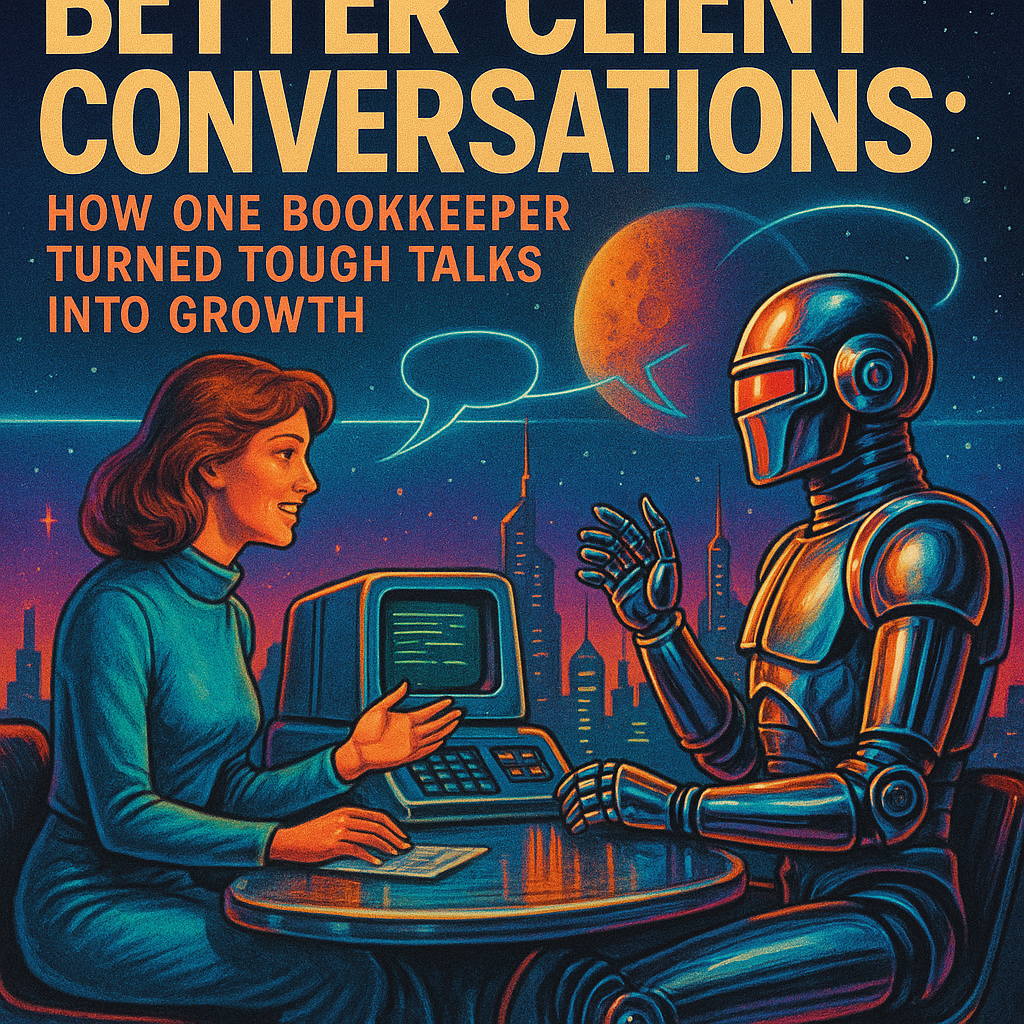
Better Client Conversations: How One Bookkeeper Turned Tough Talks into Growth
When I walked into a cramped coffee shop to meet Teresa—an anxious solo bookkeeper whose calendar was full but her profits were not—I expected the usual: pricing doubts, messy books, and scope creep. What I did not expect was a single question she asked that changed how she ran client conversations forever: “How do I have the hard talk without losing the client?”
Better client conversations are the single most underrated lever for advisory firms. They stop churn, lift margins, and create clarity that transforms relationships into predictable revenue. This article walks through the practical steps Teresa used and the exact conversation framework you can use tomorrow.
Why most client conversations fail
Most conversations start with data and drift into decisions. That’s backwards. Data without direction creates anxiety. Buyers sit in meetings waiting for reassurance. Advisors deliver numbers and leave clients confused about next steps.
Teresa’s clients were polite but passive. She packaged reports and expected action. When clients didn’t act, she followed up with more reports. The result: more hours, no extra revenue, and slowly eroding confidence on both sides.
The fix is not nicer reports. The fix is structure: a short agenda, one clear insight, and a recommended next step framed around the client’s priorities.
The three-part conversation framework that changed outcomes
Teresa adopted a three-part framework that cut meeting time and increased client follow-through. Use this framework to make your client conversations purposeful and profitable.
1) Start with the one question that matters
Open every meeting with: “What single outcome would make this session worth your time?” Keep the answer to one sentence. If the client says “I want to understand my cash situation,” you focus the rest of the meeting on that outcome.
This forces alignment instantly. It also gives you a clear measure of success for the meeting.
2) Lead with signal, not noise
Select one metric or insight that directly answers the client’s outcome. For example, if the outcome is clarity on cash, highlight the runway in weeks, the top two cash inflows next month, and the largest drain.
Present the signal in one slide or one page. No dive into minutiae unless the client asks. Teresa found that when she provided a single, confident interpretation of the data, clients stopped asking for every line item and started choosing action.
3) Offer a single recommendation with two scenarios
Always end with one recommended action and two realistic scenarios: conservative and aggressive. The conservative scenario shows minimal disruption to the business. The aggressive scenario shows the fastest path to the outcome, with trade-offs spelled out.
This technique reduces analysis paralysis. Clients can pick a scenario. If they need more time, they choose the conservative route and you gain breathing space to implement the advisory work.
Practical scripts and timing to use in your next meeting
Scripts help keep meetings focused. Here are short, field-tested lines Teresa used and the timing she followed.
Opening (first 2 minutes)
“Before we start, what single outcome would make today’s meeting worth your time?”
If the answer is unclear, suggest three quick options and ask them to pick one.
Signal delivery (next 8–12 minutes)
“Here’s the single insight that matters: [insert one metric]. That tells us [one short implication].” Pause. Ask: “Does that match what you’re seeing?”
Pause again. If they say yes, move to recommendation. If no, ask what’s different and capture the missing context.
Recommendation and close (last 5 minutes)
“Based on this, my single recommendation is X. Conservative scenario: [brief]. Aggressive scenario: [brief]. Which aligns with your tolerance and timeline?”
End by confirming responsibility: “If you choose the aggressive path, here’s what I’ll do this week and what I’ll need from you.”
How to scale these conversations across a team
Teaching a team to run these conversations requires practice and simple tools. Teresa ran three one-hour role-play sessions with her staff and introduced a one-page meeting template. The template contained the opening question, one metric box, and space for the two scenarios.
Use recorded role-plays to give feedback. Over four weeks Teresa reduced average meeting time by 30% and increased client decisions by 40%.
If you manage teams, investing time in soft-skill rehearsal produces a faster ROI than redesigning your reports.
Where conversation meets finance: using cash-focused language
When the client outcome centers on liquidity, use language that translates to decisions. Replace “accounts receivable aging” with “available cash in 30 days.” Replace “profit improvement” with “how many payrolls we can cover.” Precise, outcome-driven phrasing converts vague anxiety into actionable plans.
If you need a short primer on aligning advisory conversations to financial outcomes, resources on practical business “leadership” thinking can help frame decisions in the client’s language. leadership.
For conversations that revolve around immediate liquidity, make the link between decisions and survival explicit. If you want a compact model for predicting short-term liquidity, see the simple weekly forecast approach that ties revenue timing to spending and preserves working capital for priorities around payroll and suppliers. It’s a useful reference for advisors focused on client “cash flow” concerns.cash flow
Closing thought: conversations are a product you can improve
The first change to make is procedural: one opening question, one signal, one recommendation. The second change is cultural: train your team to lead with interpretation and responsibility.
Teresa stopped being a chronic reporter of numbers. She became a decisive guide for clients. Her meetings became shorter and more profitable. Her clients moved faster because they knew the decision and the consequence.
Better client conversations do not require more data. They require a better use of the data you already have. Start with one question in your next meeting and measure whether decisions increase. If they do, keep the format and scale it. Your advisory work becomes more valuable when clients leave meetings knowing what to do next.
Leave a Reply