Blog

  • Why Authority, Not SEO Tricks, Is Winning Visibility in AI Search

    Why Authority, Not SEO Tricks, Is Winning Visibility in AI Search

    Businesses are entering a new phase of search visibility, one that rewards credibility more than manipulation. As AI-driven search experiences reshape how people discover information, the companies that stand out are not the ones chasing shortcuts. They are the ones building real authority, and that shift is changing the rules for content, branding, and digital strategy.

    The argument is simple: AI search systems are designed to synthesize trusted sources, not reward tactical loopholes. That makes authority harder to fake and easier to recognize. For a deeper look at that idea, see Jeffrey Robertson’s analysis of why the businesses winning AI search are building authority, not gaming Google.

    AI Search Is Changing What Visibility Means

    Traditional search optimization has long centered on ranking signals, keyword targeting, and link acquisition. Those tactics still matter, but they no longer tell the full story. AI-powered search tools increasingly summarize information from multiple sources and elevate the businesses that appear most reliable, consistent, and useful across the web.

    That shift changes what it means to be visible. Instead of asking whether a page can rank for one query, businesses now need to ask whether their brand is recognizable enough to be cited, summarized, or recommended by a system that evaluates broader context.

    This is especially important because AI search does not just surface pages; it often surfaces answers. If a brand’s expertise is thin, inconsistent, or difficult to verify, it is less likely to appear in those answers. Authority, in this environment, becomes more than a marketing word. It becomes a practical requirement.

    Why Authority Carries More Weight Than Short-Term SEO Wins

    Authority is built through signals that are difficult to manufacture at scale. Clear subject expertise, original insight, consistent publishing, and a strong reputation across relevant channels all contribute to how a brand is perceived by both audiences and search systems.

    Businesses that focus only on technical optimization often miss this broader picture. They may attract traffic temporarily, but they do not necessarily create the kind of trust that AI search systems appear to favor. A page can be tuned for a keyword and still fail to convince a system that the business behind it is a credible source.

    That is why authority-driven marketing is becoming more important than ever. It does not rely on tricking an algorithm. It relies on building something worth surfacing in the first place.

    Key elements of authority-building include:

    • Publishing content that demonstrates actual expertise, not just topical coverage
    • Maintaining consistency in messaging across the website, profiles, and editorial content
    • Earning mentions and citations from reputable sources in the same field
    • Making it easy for people and systems to understand who the business is and what it stands for
    • Answering real questions with depth rather than producing generic content at scale

    These are not new concepts, but they are receiving renewed attention because AI search magnifies the difference between surface-level content and genuinely useful material.

    What Businesses Should Do Now

    The companies best positioned for AI search are likely to be the ones already investing in brand substance. That means improving more than just search pages. It means strengthening the entire information footprint that surrounds the business.

    A practical approach starts with clarity. Businesses should define their core areas of expertise and make sure those themes are reflected consistently in website copy, blog content, service pages, and external profiles. When a brand is clear about what it does, it becomes easier for search systems to classify and trust it.

    Next comes depth. Generic posts and recycled summaries are less likely to stand out in an environment where AI tools can process huge volumes of similar content. Original commentary, real examples, and specific insights help distinguish a brand from competitors that are saying the same thing in slightly different words.

    Finally, businesses need to think beyond their own site. Authority is strengthened when other credible sources reference the brand, when industry peers acknowledge its work, and when its content is worth citing. That does not mean chasing volume for its own sake. It means earning relevance in places that matter.

    The Long-Term Advantage Belongs To Trusted Brands

    The shift toward AI search is not a temporary trend. It reflects a broader move toward systems that prioritize confidence and context over manipulation. Businesses that understand this are less likely to waste time on tactics that age quickly and more likely to invest in assets that compound over time.

    That makes authority a strategic advantage, not just a branding preference. It affects how a business is discovered, how it is summarized, and whether it is seen as a credible source when people search for information or solutions.

    The message for marketers and business leaders is clear. The future of search visibility will not be won by the brands trying to outsmart the system. It will be won by the brands that give the system a reason to trust them.

  • How to Have Better Client Conversations That Change Decisions

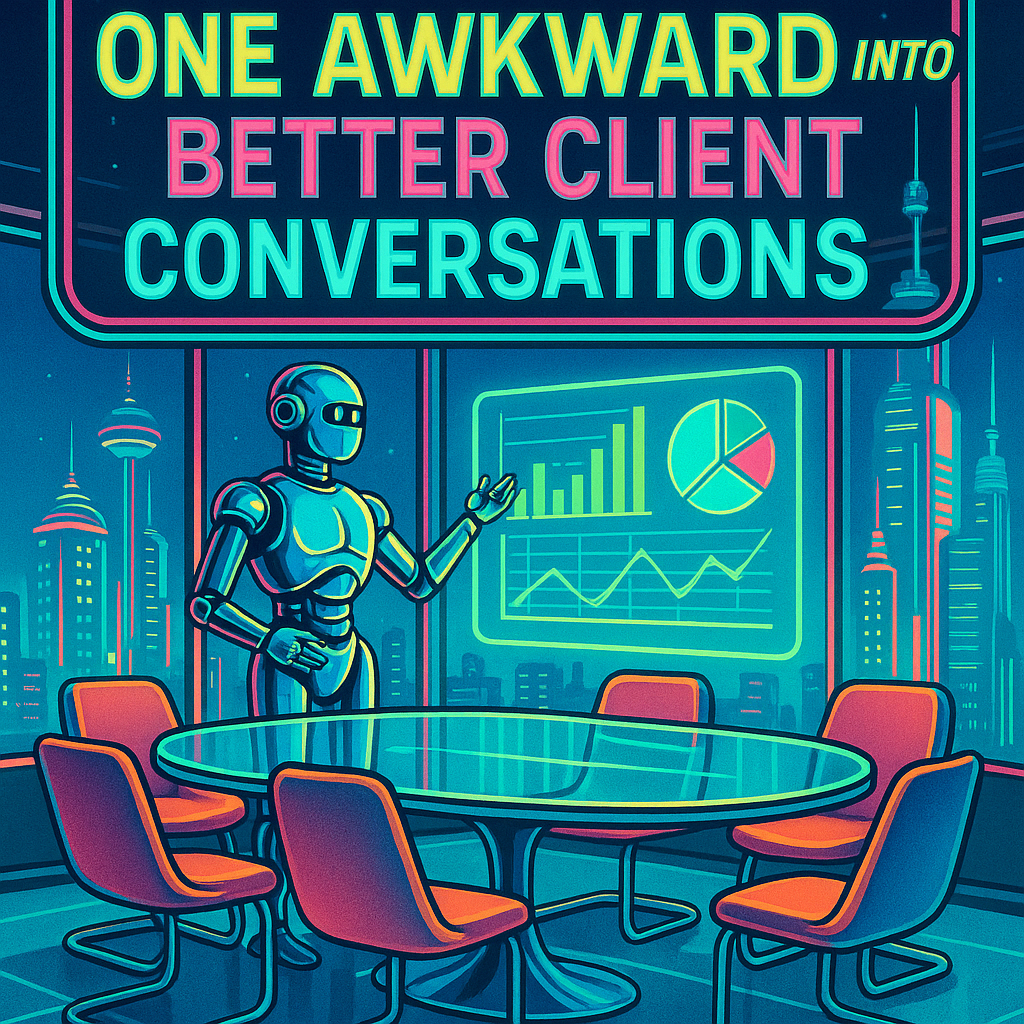
    How to Have Better Client Conversations That Change Decisions

    How to Have Better Client Conversations That Change Decisions

    I learned the hard way that better client conversations do not start with data. They start with a question that matters to the owner and a way to prove progress quickly. That realization came in a midsize manufacturer I worked with where months of reporting produced zero change. We changed one conversation and the company stopped burning cash.

    The problem was familiar: advisors delivered neat reports, clients nodded, and nothing moved. The advisory gap sits between insight and action. This article shows a practical path for Client Advisory Service providers, accountants, bookkeepers, and business coaches to turn routine meetings into decision-driving conversations.

    Frame the conversation around a single, measurable decision

    Too many meetings try to solve everything. Pick one decision the client can make within 30 days. That clarity focuses analysis, saves time, and creates momentum.

    Start each cadence by asking: What choice should we make at the next meeting? If the answer is vague, probe until it is concrete. A decision could be pricing a product, pausing a service line, or hiring a headcount to cover a revenue gap.

    Agree on the metric you will use to evaluate the decision. Make that metric visible in the first three minutes of the meeting. Commit to one owner for follow-up. Repeat this structure for several months. Small, consistent decisions compound.

    Use short experiments to test assumptions

    Clients default to long reports and long waits. Replace that with short experiments that test hypotheses. An experiment can be a one-week price change, a revised payment term, or a temporary marketing channel shift.

    Design experiments to be low cost and time-bound. Capture the outcome in the metric you agreed on. If an experiment shows a clear signal, scale it. If it does not, document why and move on. The goal is to learn faster than competitors and stop acting on hunches.

    When you present an experiment outcome, describe the setup, the signal, and the next recommended action. That keeps conversations practical and forward-looking.

    Rebuild trust with cadence and visible progress

    Trust is the currency for advisory impact. You earn it by showing progress more often than you promise it. Weekly or biweekly check-ins that report one metric beat quarterly deep-dives that ask for faith.

    Structure meetings around three short points: the decision metric, one experiment result, and one obstacle requiring client attention. Keep each point crisp and assign one owner. Clients will stop asking for more slides when they see tangible progress.

    For teams that struggle to keep commitments, add a brief pre-meeting note that lists the decision for the meeting and the data that will be shown. Preparation reduces surprise and keeps the conversation tactical.

    Ask coaching questions that uncover constraints, not excuses

    Good advisors stop diagnosing and start coaching. Replace why questions with what and who questions. Ask: What constraint is stopping that decision? Who benefits if we act? What would make this decision irreversible?

    Those questions move clients from explaining to problem-solving. You will hear fewer rationalizations and more actionable constraints. Turn those constraints into the focus for your next experiment.

    When clients bring emotional resistance, acknowledge it and reframe it as a hypothesis to test. Emotions often point to hidden risks you can design experiments around.

    Use the right artifacts to keep conversations practical

    Slide decks create inertia. Use three artifacts instead: a single metric dashboard, an experiment brief, and a short decision log. The dashboard shows the decision metric. The experiment brief outlines setup, risk, and expected signal. The decision log records the choice, owner, and date.

    Place a contextual link in the experiment brief when a client needs a thought leader or framework. For example, when a team needs to align on operating principles, reference research on leadership that frames accountability without jargon. When a discussion centers on available liquidity, share an objective primer on cash flow to align everyone on short-term tradeoffs.

    These artifacts reduce meeting time and create an institutional memory that survives staff changes.

    Closing insight: make every conversation a micro-intervention

    Treat advisory conversations as micro-interventions that change the immediate next step. Small, deliberate decisions compound into operational stability and growth. Your role is not to present perfect answers. Your role is to help clients test assumptions, make one measurable choice, and follow through.

    If you leave a meeting with one clear owner, one measurable metric, and one short experiment, you have moved from reporting to advising. Over time those micro-interventions become the firm’s operating rhythm. That rhythm is what separates firms that look busy from firms that change outcomes.

    Make better client conversations the default. Start with a decision, test it quickly, and document the result. Do that enough times and you no longer report history. You change it.

  • Operator Syndrome: The Hidden Costs of Living in Survival Mode

    Operator Syndrome: The Hidden Costs of Living in Survival Mode

    For many people, operating under constant pressure can feel normal long after it becomes unhealthy. The body adapts, the mind narrows its focus, and the work keeps getting done — but often at a steep personal cost. In a recent essay on operator syndrome and the hidden cost of living in survival mode, the issue is framed as more than stress or burnout: it is a pattern of chronic overdrive that can shape how people think, feel, recover, and relate to others.

    What It Means To Live In Survival Mode

    Survival mode is often described as a short-term response to threat, urgency, or high demand. In that state, attention sharpens, priorities simplify, and a person may become highly effective at handling immediate problems. The difficulty begins when that state stops being temporary.

    When pressure becomes a default setting, the nervous system can stay locked into vigilance. That may look like relentless productivity on the surface, but beneath it are common signs of depletion: poor sleep, irritability, difficulty concentrating, emotional flattening, and a growing sense that rest is unsafe or undeserved.

    Operator syndrome, as discussed in the linked article, captures this longer arc. It suggests that the cost is not only fatigue, but also the erosion of balance — physical, emotional, and relational. People may continue performing at a high level while losing access to the parts of life that make that performance sustainable.

    The Hidden Costs That Often Go Unnoticed

    One reason survival mode is so difficult to address is that it can be rewarded. High achievers, caregivers, founders, first responders, and others in demanding roles are often praised for endurance. The ability to keep going becomes evidence of strength, even when it is masking strain.

    The hidden cost is that the body rarely distinguishes between useful urgency and chronic pressure. Over time, the system may remain stuck in a cycle of activation with too little recovery. That can affect energy, mood, decision-making, and even a person’s capacity for empathy and patience.

    There is also a social cost. When life is organized around constant response, relationships can become transactional. Conversations get shorter, boundaries blur, and people may stop noticing what they need until the breakdown becomes impossible to ignore. In this way, operator syndrome is not just an individual problem; it can reshape the culture of a family, team, or organization.

    Common Patterns That Can Signal Trouble

    While the experience varies, several patterns often appear when someone is functioning in survival mode for too long:

    • Persistent fatigue that rest does not fully resolve
    • A short fuse or heightened reactivity to minor setbacks
    • Trouble sleeping, staying asleep, or waking unrefreshed
    • Reliance on adrenaline, caffeine, or urgency to get through the day
    • Feeling disconnected from enjoyment, purpose, or creativity
    • Difficulty slowing down without guilt or anxiety

    These signs do not automatically point to one diagnosis, but they do suggest that the current way of operating may no longer be sustainable.

    Why High Function Can Mask Deeper Strain

    A major challenge in recognizing operator syndrome is that external success can hide internal distress. A person may still be meeting deadlines, leading teams, caring for others, or performing publicly at a high level. From the outside, everything looks intact.

    Inside, however, the cost may be accumulating quietly. When survival mode becomes habitual, a person can lose touch with basic signals such as hunger, exhaustion, sadness, or the need for support. The habit of pushing through becomes so normalized that slowing down feels unfamiliar or even threatening.

    This is one reason the conversation around survival mode matters. It asks a different question than “Can this person keep performing?” It asks whether the current pace is damaging the conditions that make performance possible in the first place.

    Moving From Reaction To Recovery

    Recovery from chronic survival mode rarely starts with a dramatic reset. More often, it begins with noticing. Naming the pattern is an important first step because it helps separate identity from habit. A person is not their stress response, and high output is not a complete measure of health.

    From there, recovery tends to require more than a single wellness practice. It may involve better boundaries, more consistent sleep, reduced exposure to avoidable stressors, and deliberate periods of restoration. For some people, it also means reevaluating beliefs about worth, productivity, and responsibility.

    Just as important is the role of support. Chronic survival mode can narrow perspective, making it harder to see alternatives. External guidance — whether from a clinician, coach, mentor, or trusted professional — can help people identify the patterns they cannot easily see on their own.

    The Case For Early Attention

    The earlier survival mode is recognized, the easier it is to interrupt. Waiting until crisis often means dealing with a larger, more complicated recovery process. Early attention, by contrast, can preserve functioning before chronic strain hardens into a long-term pattern.

    That is part of the value of work like the discussion of operator syndrome on Jeffrey Robertson’s site. It shifts the focus from simply admiring resilience to asking what resilience costs when it becomes constant. That question is increasingly relevant in workplaces and homes where pressure is normalized and recovery is treated as optional.

    The conversation is not about lowering standards or abandoning responsibility. It is about recognizing that sustained performance depends on sustainability. When people are given room to recover, they are more likely to think clearly, relate well, and contribute over the long term. In that sense, addressing survival mode is not a retreat from effectiveness — it is a condition for it.