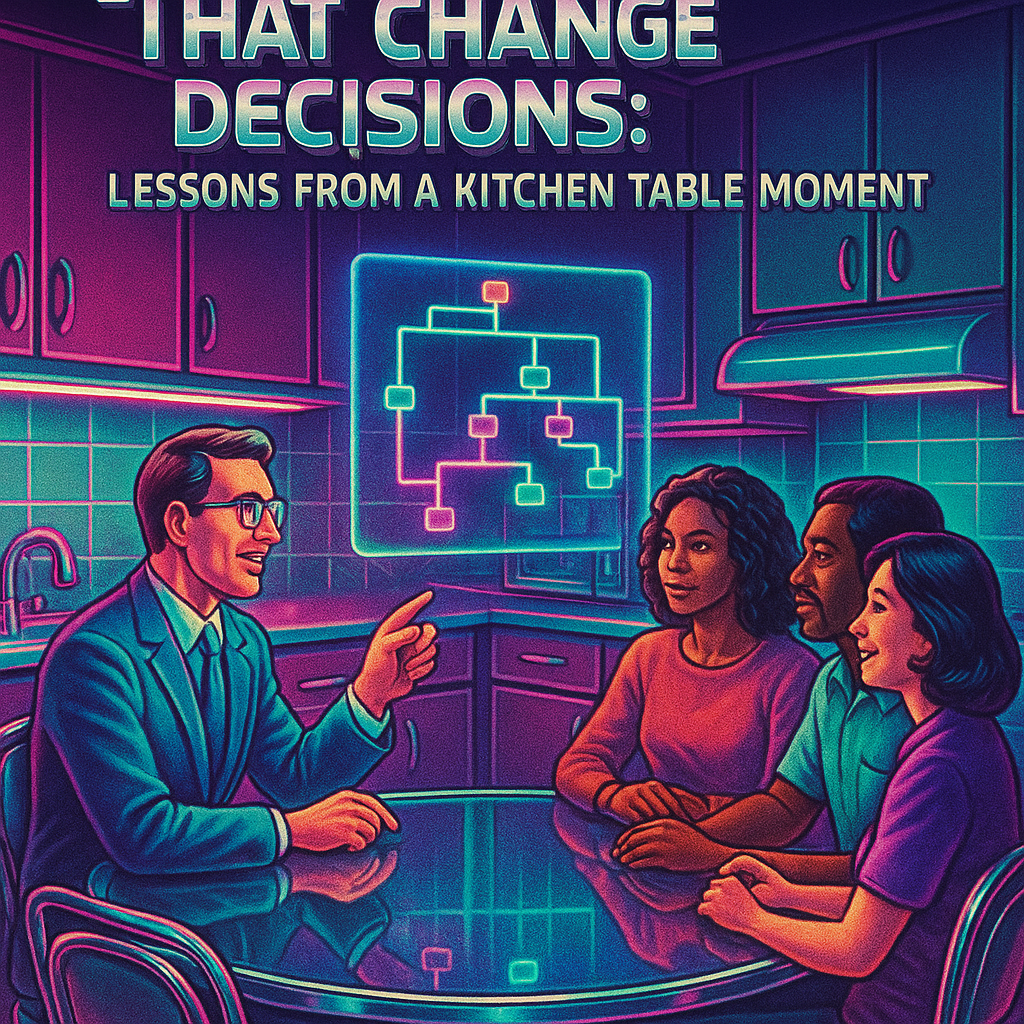
Better Client Conversations That Change Decisions: Lessons from a Kitchen Table Moment
When I first sat across from a small business owner at her kitchen table, she had three years of profitless growth and a stack of invoices she avoided. She wanted to know whether to hire a sales lead. Her eyes flicked between the spreadsheet and her phone. That meeting taught me one thing: better client conversations do not start with numbers. They start with one clear question that frames the decision.
Framing the problem incorrectly makes every recommendation fragile. If you begin with a hire or a tax tactic, you may win the argument but not the outcome. The owner needed clarity about timing, risk, and operating capacity. The conversation that followed—short, disciplined, and anchored in practical tradeoffs—changed her plan. She delayed the hire, reduced vendor spend, and reclaimed a month of runway.
Open with a single decision, not a report
Walk into meetings with the exact question you want the client to decide. “Should we hire a sales lead now?” is better than “Here’s last quarter’s report.” A tight question forces both of you to define success and identify the information that matters.
Start the meeting by writing the decision on a notepad. Ask the client to describe the upside and the downside in one sentence each. That flips the dynamic from passive listening to active tradeoff analysis.
When you lead with the decision, you shorten the meeting and increase the odds the client leaves with clarity. That clarity makes follow-up easier and reduces the need to revisit the same topic four meetings later.
Use three lenses to move from numbers to recommendations
Every financial or operational choice lives in three lenses: timing, capacity, and consequence. Run each idea through those filters in that order.
Timing asks whether the market or season makes this the right moment. Capacity asks whether the business has the people and systems to absorb the change. Consequence maps financial and non-financial risks the owner must accept.
In the kitchen-table case, timing revealed a seasonal dip in sales. Capacity showed the operations team could not support a new hire without a two-week onboarding plan. Consequence exposed a cash runway of eight weeks if revenue dropped by 10 percent. That trio of facts made the hire an avoidable risk that month.
Translate numbers into a short decision memo
After the meeting, send a one-paragraph decision memo. Say what was decided, why, what will change, and the review date. Keep it short. Busy owners skip long reports but read read-ahead memos and checklists.
A simple format works: Decision, Rationale, Immediate Steps, Metrics to Watch, Review Date. For example: “Decision: Delay sales hire six weeks. Rationale: Seasonality and onboarding capacity. Steps: Reduce vendor spend by 15%, create 2-week onboarding checklist. Metrics: Weekly cash balance, sales pipeline conversion. Review: April 20.”
This memo becomes your single source of truth. It prevents circular conversations and anchors future meetings to measurable checkpoints.
Handle emotions and biases before you handle numbers
Owners carry emotional stakes. Pride, fear, and identity distort analysis. Rather than argue with emotion, name it. Say, “I hear the urgency. Let’s capture that and test it.” Naming reduces defensiveness and moves the conversation back to measurable tradeoffs.
Use a simple bias check: ask the owner what would be the easiest thing to believe and what would be the hardest. That exposes confirmation bias and surfaces the data you actually need.
When emotions are high, slow the meeting and schedule a short follow-up with a narrower scope. A calmer conversation produces clearer choices.
Make leadership visible and practical in the room
Better client conversations sometimes require explicit leadership—helping a client trade hope for a plan. Offer clear roles: who will own execution, who will monitor metrics, and who will decide if the plan changes.
When you assign roles, link them to a single point of accountability. That avoids diffusion and speeds execution. If the client needs examples of how to structure roles, a short primer on effective leadership can help. For practical frameworks and coaching on how to set those responsibilities, explore resources on leadership. (See leadership.)
Link decisions to the business’s cash story
Every operational decision changes the business’s cash flow. Translate recommendations into a cash story: what moves the cash balance in, what moves it out, and how long the runway lasts under stress.
In the kitchen-table example, converting hiring risk into a cash story made the decision obvious. We modeled worst-case weekly burn and the owner could see when a temporary cut in discretionary spend preserved runway. If you want a simple calculator or resource that helps clients see how decisions affect runway and operating choices, use a practical cash flow reference to illustrate those effects. (See cash flow.)
Close the loop with a short learning review
Two weeks after the decision, perform a five-minute learning review. Ask: Did the decision have the intended effect? What assumptions were wrong? What will we do differently next time?
Short reviews compound. They build a habit of learning that turns meetings from debates into experiments. Over months, your clients become faster at deciding and better at anticipating consequences.
Final insight: design conversations that force tradeoffs
Clients rarely lack information. They lack a framework to use it. Better client conversations force tradeoffs, assign accountability, and connect choices to cash. Start every meeting with the decision, run ideas through timing-capacity-consequence, and close with a one-paragraph memo and a short review.
Do this consistently and you will move clients from confusion to clarity. They will stop asking what to do and start asking how to make their choice succeed. That shift is the quiet, high-leverage work that changes outcomes for owners and makes advisory relationships genuinely useful.